
17
Apr, 2026

admin
Follow
Is Your Contract Governed by Chinese Law? What the New China Maritime Rule Means for Shipping Contracts
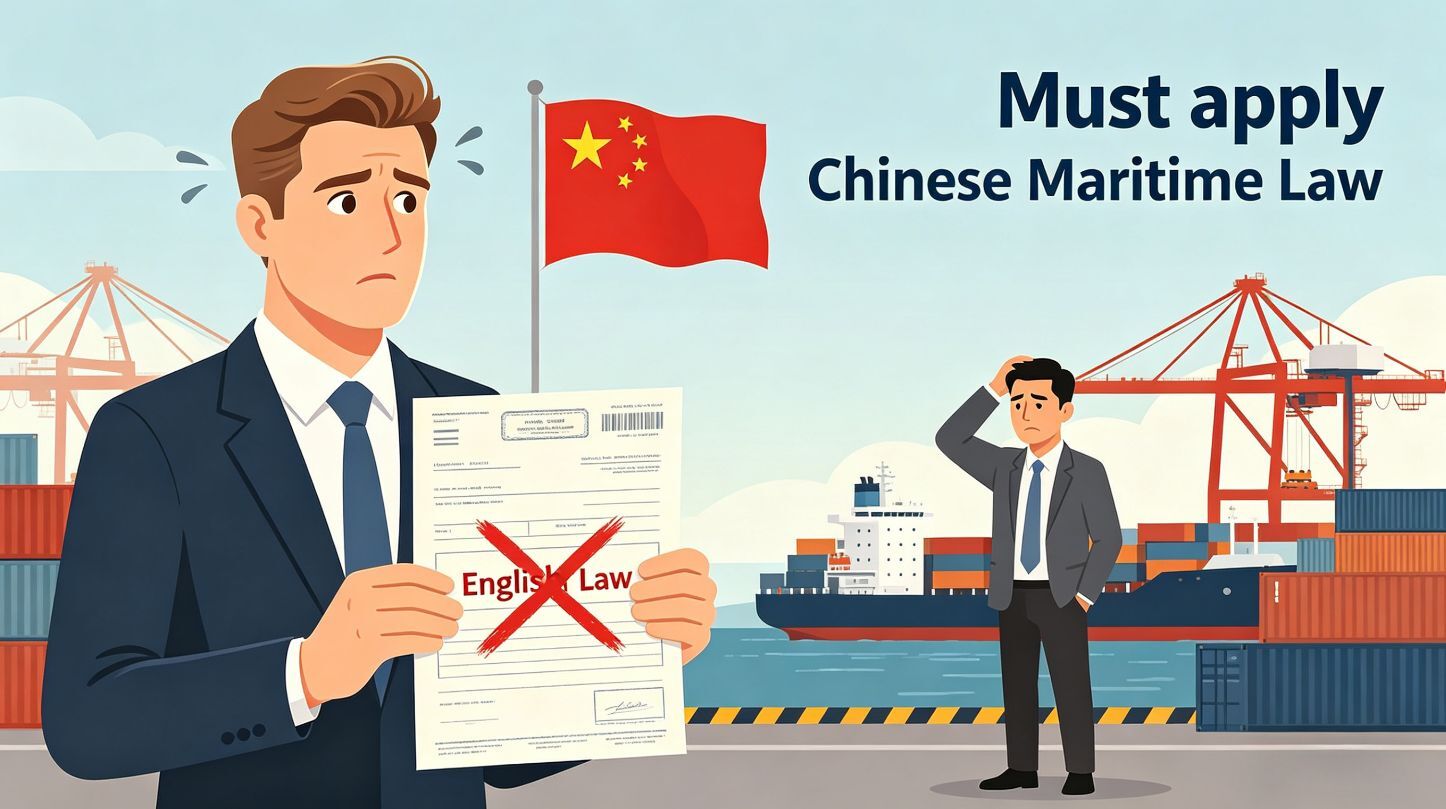
A major change is coming to China’s maritime legal framework. The revised Maritime Law of the People’s Republic of China was passed on 28 October 2025 and is set to take effect on 1 May 2026. Among the most important updates for cargo interests, carriers, freight forwarders, and insurers is the new governing-law rule for international carriage of goods by sea involving a Chinese port.
For anyone moving cargo to or from China, this is not a technical footnote. It is a contract-risk issue. Under the revised law, where the port of loading or the port of discharge in an international contract of carriage of goods by sea is located in China, Chapter IV of China’s Maritime Law applies. In practice, that means parties can no longer assume that a foreign law clause printed on a bill of lading will necessarily control the dispute if a Chinese port is involved.
What changed?
Under the prior Maritime Law, Chapter IV did not apply to domestic carriage of goods by sea between ports in the People’s Republic of China. The official English version of the earlier law reflects that exclusion. The revised law removes that older framework and expands the application of Chapter IV, while also introducing a clearer rule for foreign-related disputes under Article 295.
The practical consequence is straightforward: if your shipment is part of an international sea carriage and either the loading port or discharge port is in China, Chinese maritime law may apply mandatorily to the carriage contract under the revised regime.
Why this matters for bills of lading
Bills of lading are often treated as standardized operational documents, but they are also legally powerful contract instruments. According to commentary on the revised law, if a bill of lading states foreign governing law, or tries to import a charterparty’s foreign law or jurisdiction/arbitration terms into the bill of lading, those clauses may be treated as invalid where Article 295 applies.
That is a serious shift for parties who have historically relied on English law, Singapore law, or other foreign governing-law structures in their shipping documents. The issue is not simply where a dispute is heard; it is which law applies at all to the underlying carriage relationship when a Chinese port is involved.
What the rule appears to cover
The reported rule is focused on international maritime carriage of goods by sea. It does not, based on the available materials, extend in the same way to air, rail, or road transport. The sources reviewed describe the change specifically in the context of carriage of goods by sea and the application of Chapter IV of the Maritime Law.
That distinction matters. Many supply chains are multimodal, but this amendment is aimed at sea carriage. Companies should not assume that a transport package as a whole is affected in the same way as the ocean leg. The legal impact should be assessed shipment by shipment and document by document.
Who should pay attention?
This change is especially relevant for carriers, shippers, consignees, freight forwarders, NVOCCs, and insurers. The revised law is part of a broader modernization of China’s maritime framework, including updates on liability, electronic transport records, and rules for foreign-related matters. But for commercial parties, the most immediate issue is whether existing contract templates still work as intended once the law becomes effective on 1 May 2026.
If your current templates contain foreign governing-law clauses, foreign jurisdiction clauses, arbitration clauses, or incorporation language from charterparties into bills of lading, those provisions should be reviewed carefully before the effective date. The risk is not merely theoretical; the revised law is designed to give Chinese law priority in the scenarios described above.
Immediate actions to consider
First, review all bill of lading templates used on China-related trades. Check the governing-law clause, jurisdiction clause, arbitration clause, and any incorporation wording. If the shipment involves a Chinese loading or discharge port, assume the clause may be challenged under the revised law.
Second, review charterparty wording and back-office booking terms. Many businesses use one set of terms across multiple trades without differentiating by route. That approach may create hidden exposure where Chinese ports are involved.
Third, coordinate legal and operational teams now, not after a dispute arises. Contract language, claims handling, documentary practice, and cargo release procedures should all be aligned before 1 May 2026.
The bigger picture
This reform reflects a broader effort by China to modernize its maritime law framework and align it more closely with current shipping practice and international trade realities. The revision also introduces or clarifies rules on electronic transport records and other commercial issues, indicating that the law is being updated not only for dispute resolution, but also for digital and operational developments in shipping.
For businesses, however, the headline issue remains simple: assumptions built into old shipping templates may no longer hold. A clause that looked routine last year may be ineffective in a China-related ocean shipment next year.
Final takeaway
If your contracts touch a Chinese port, now is the time to review your shipping terms, bill of lading wording, and dispute resolution clauses. The revised Maritime Law will take effect on 1 May 2026, and the new foreign-related rule in Article 295 could materially affect how disputes are governed and resolved. Do not wait until cargo is delayed or a claim is filed to discover that your chosen law clause is no longer doing what you expected.
This article is for general informational purposes only and is not legal advice. For contract-specific guidance, maritime counsel should review the relevant trade lane, transport document set, and dispute resolution framework before the effective date.
0