
09
Mar, 2026

admin
Follow
Why transit time for FCL and LCL cargo to the same destination could be different
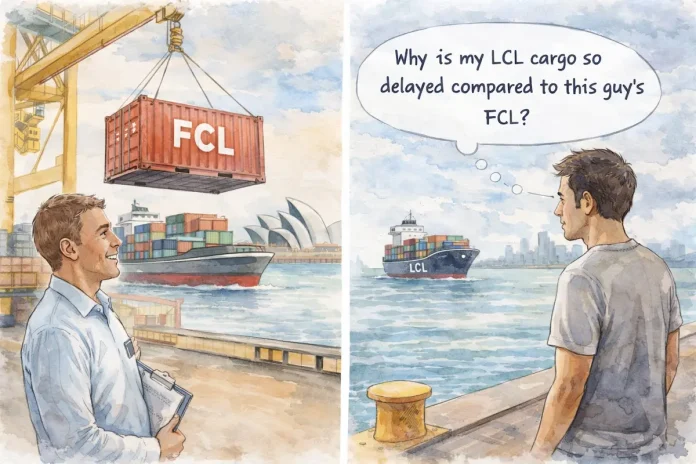
FCL and LCL cargo moving to the same destination port can have transit time differences of 10 days or more.. An FCL container from Durban to Sydney takes approximately 31 days, while an LCL shipment on the same route can take 43 days or longer, because LCL cargo is reworked at a transhipment hub like Singapore or Port Klang before onward consolidation..
Can there be a difference in transit time between FCL and LCL cargo to the same destination..?? If so, why..??
This was very valid question from Kehkashan Mashal Zaffar on the readers of this resource..
Before I answer the question, it is important to understand the difference between FCL and LCL, especially if you are new to the industry..
Full Container Load (FCL)
FCL : Full Container Load – this is when the full container is used by a single customer for his cargo..
FCL containers are packed and unpacked either by the client at his premises at the origin and destination or using a 3rd party warehouse..
The client takes responsibility, liability for the packing and condition of the cargo packed in the FCL container..
Less than Container Load (LCL)
 100vw, 277px” data-lazy-srcset=”https://i2.wp.com/shippingandfreightresource.com/wp-content/uploads/2009/03/lcl.png?w=277&ssl=1 277w, https://i2.wp.com/shippingandfreightresource.com/wp-content/uploads/2009/03/lcl.png?resize=50%2C50&ssl=1 50w” data-recalc-dims=”1″ data-lazy-loaded=”1″ data-lazy-src=”https://i2.wp.com/shippingandfreightresource.com/wp-content/uploads/2009/03/lcl.png?resize=277%2C273&ssl=1″ /></p>
<p><strong>LCL</strong> : Less than Container Load – this is when the same container is used for cargoes belonging to multiple shippers and consignees..</p>
<p>The clients deliver their cargo to the lines packing station (<strong>CFS – Container Freight Station</strong>) and the line then packs the delivered cargo on behalf of the client..</p>
<p>In the case of LCL containers, the shipping line takes responsibility and liability for the packing, condition and delivering of the cargo..</p>
<p><strong>Point to ponder:</strong> Not all shipping lines offer LCL services in all countries.. In South Africa, for example, lines do not offer LCL services and such shipments are handled by Groupage operators..</p>
<p>This has been the case for many years, though LCL service availability varies by market and can change as shipping lines adjust their CFS networks and commercial strategies..</p>
<p>Always confirm current LCL service options with your freight forwarder from your specific origin country..</p>
<h3><strong>Groupage Operator</strong></h3>
<p>Similar to LCL with the only difference that these containers, cargo packing etc are controlled by a Groupage operator instead of the shipping lines in the case of LCL containers..</p>
<p>The Groupage operator books the container with the shipping line as their cargo depending on how much cargo they have (20′ or 40′).. Also known as a <a href=) Consol Box..
Consol Box..
 100vw, 1200px” data-lazy-src=”https://www.shippingandfreightresource.com/wp-content/uploads/export-consolidation-transit-time-lcl-vs-fcl.webp” /></p>
<p>Once the cargo is packed, they issue their own House Bills to their clients and collect the Master Bill of lading from the shipping line..</p>
<h2><strong>The reason for difference in transit time between FCL and LCL..</strong></h2>
<p>In the case of FCL – the container is carrying cargo for one shipper and one consignee and once it is packed at the Port of Load, it is not reworked anywhere and delivered as is to the Port of Discharge.. It may however, be re-handled at a <a href=) Transhipment port in case there is no direct service from point to point..
Transhipment port in case there is no direct service from point to point..
For example, let’s take an FCL container from Durban, South Africa to Sydney, Australia.. The container is not opened or cargo re-worked along the way, but the full container may be transhipped at some hub port like Singapore or Port Kelang..
So the transit for an FCL container could be 31 days from Durban to Sydney..
How does LCL cargo get reworked at a transhipment hub..??
In the case of LCL (or Groupage) cargo – the shipping line or groupage operator will load cargoes belonging to many shippers and many consignees in the same container going to various destinations like Keelung, Penang, Sydney, Adelaide, Honiara in Solomon Islands..
The container may be discharged at Singapore which could be the hub port of the shipping line or groupage operator where this container will be reworked and cargoes distributed to the various ports by consolidating a container containing all cargoes to Keelung, all cargoes to Penang, all cargoes to Sydney etc..
So the groupage operator or consolidator consolidates all LCL cargoes to a specific destination and converts it to an FCL container for them..
If there is not enough cargo for Sydney, from this LCL container and other LCL containers coming from around the world, the Sydney cargo may wait in Singapore till there is enough cargo to Sydney to fill a container..
So an LCL cargo bound from Durban to Sydney might take 43 days by the time it reaches Sydney after the reworking etc whereas an FCL cargo will take lesser than that..
Why exotic ports like Honiara add more days to LCL transit
Sydney is a common port, so the delay (if any) might be very minimal, but if you take for example an exotic port like Honiara, which is not as popular as Sydney, the cargo could wait longer in Singapore..
And if there is no direct connection from Singapore to Honiara for the LCL cargo, this might have to be further reworked at another hub port..
Below diagram should help clarify (click on the image if you can’t read it clearly)

Article FAQ
Why is there a difference in transit time between FCL and LCL to the same destination..??
Why does LCL cargo take longer than FCL even on the same vessel..??
How does a groupage operator differ from a shipping line in handling LCL..??
Critical Note: Can LCL cargo get delayed at multiple points, not just one hub..??
0