
09
Sep, 2026

admin
Follow
Two ships just gave us the first real data on Arctic container shipping. It’s messier and more interesting, than “the Arctic is faster.”
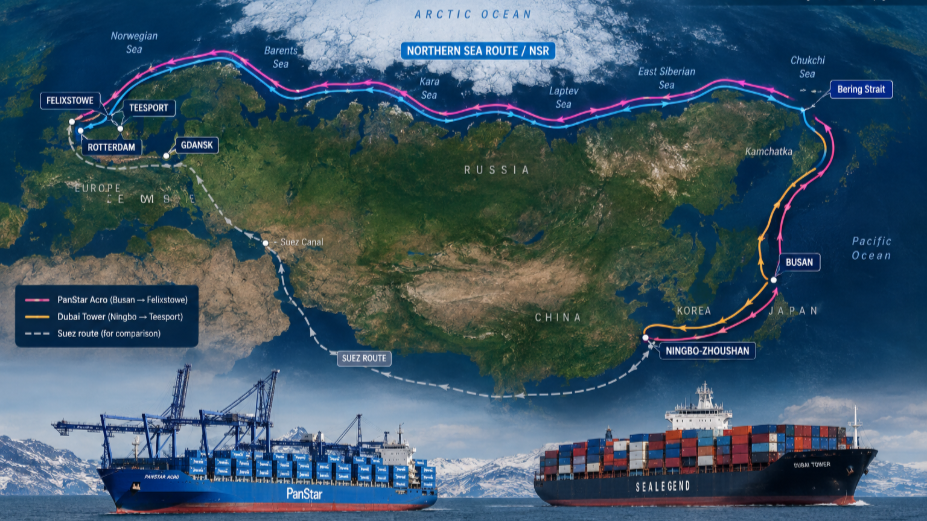
The Northern Sea Route has now proven something important:
Commercial container ships can sail from Northeast Asia to Northern Europe through the Arctic and do it noticeably faster than via Suez.
That’s the easy part.
The hard question is whether the NSR can turn that time advantage into a repeatable, reliable, economically competitive container service.
Two ships have just completed the first real-world test:
PanStar Acro – 2,758 TEU – Busan → Felixstowe – 21 days
Dubai Tower – 1,740 TEU – Ningbo-Zhoushan → Teesport — 25 days
Real ships. Real cargo. Real route.
And together, they tell two very different stories.
South Korea is testing feasibility. China is starting to test repeatability.
That distinction may matter more than any number of kilometres saved.
1. The strongest argument for the NSR is TIME
South Korea estimates roughly 20 days Busan–Rotterdam via the Arctic, versus about 30 days via Suez.
The distance gap is real too:
- Busan–Rotterdam via Arctic: ~13,000 km
- Busan–Rotterdam via Suez: ~20,000 km
That’s roughly a 35% cut in sailing distance – over 10 days potentially saved, according to Korea’s own trade-policy institute.
The PanStar Acro backs this up with real transit data: it departed Busan on August 22, entered the Northern Sea Route on August 31, and reached Felixstowe 21 days after departure – the first time a South Korean container ship has made the crossing.
So one conclusion is already solid: the NSR can materially cut transit time, and time has real economic value – lower fuel burn, faster inventory turnover, less capital tied up in transit, possibly fewer vessels needed to hold a given service frequency.
But a shorter voyage doesn’t automatically mean a cheaper supply chain.
2. The uncomfortable number: utilization
PanStar Acro has a nominal capacity of 2,758 TEU.
It sailed with about 737 TEU of paying cargo -well short of the ~1,300 TEU South Korea’s government had hoped to secure – plus roughly 100 empty containers repositioned along for the ride.
That’s about 27% commercial utilization. Even counting the empties, the ship left port around 30% full.
This isn’t a failure. It’s a pilot, and pilots exist to generate data. But commercially, it’s the number that matters most.
A container ship doesn’t earn money by arriving early. It earns money by moving paying boxes. The real question isn’t “how many days did we save” – it’s “how much revenue did the ship generate during those days.”
3. Why the Korean voyage isn’t a normal market test
South Korea isn’t leaving this to chance. The Korea Shipowners’ Association is reportedly offering more than $2 million for simply completing the one-way voyage, plus roughly $700,000 more if the round trip carries at least 2,000 TEU.
Call it what it is: the government is paying to buy something a shipping company normally spends years earning – real operational data on fuel burn, ice navigation, insurance, port handling, and schedule reliability.
That’s strategically smart. It also means this voyage tells us little about normal commercial profitability — the numbers are being generated under exceptional financial support, not market conditions.
4. Then Dubai Tower flips the script
China’s 1,740-TEU Dubai Tower left Ningbo-Zhoushan on August 15 and reached Teesport, UK, on September 9 – 25 days later, running the same Northern Sea Route.
Reported cargo figures vary slightly by source (roughly 1,300–1,500 containers), but landing around 1,300 TEU of actual freight – batteries, energy-storage systems, and solar/photovoltaic components – puts utilization at roughly 75%.
Compare the two voyages:
PanStar AcroDubai TowerCapacity2,758 TEU1,740 TEUCommercial cargo~737 TEU~1,300 TEUUtilization~27%~75%
Not a perfect apples-to-apples comparison – different ships, different cargo mixes, different commercial structures. But the gap is real, and it says something about how far along each experiment is.
5. China is asking a different question
Dubai Tower is the first of eight planned Arctic sailings in Sea Legend’s China–Europe Arctic Express for the 2026 season, running through October.
One successful voyage proves this is possible. Eight voyages start testing can we repeat it.
And repeatability – not a single headline crossing- is where shipping economics get interesting. A corridor isn’t built on one good trip. It’s built on frequency, cargo, reliability, and predictable costs.
That’s why China’s sequence of sailings deserves at least as much attention as the transit-time headline. If the service keeps hitting solid utilization without exceptional subsidy, the commercial case gets real. We’re not there yet – eight scheduled sailings is a plan, not proof.
6. Eight voyages still don’t prove profitability
We still don’t have full visibility into total voyage cost – fuel, Arctic navigation fees, icebreaker requirements, insurance premiums, port charges, schedule-disruption cost, empty-container repositioning, or actual freight rates paid by customers.
Anyone declaring the NSR “cheaper than Suez” outright is getting ahead of the data.
Here’s what we do have: South Korea’s own Maritime Institute has estimated a single summer Busan–Rotterdam voyage costs around $3 million via the Arctic, versus about $3.83 million via Suez – oughly 22% cheaper on a per-voyage basis. That’s a meaningful data point in the NSR’s favor.
But a lower total voyage cost doesn’t settle the argument, because it doesn’t tell you the cost per loaded container – and that depends entirely on how full the ship is. A cheaper voyage carrying 27% of its capacity can still be a more expensive way to move each individual box than a costlier voyage sailing nearly full.
7. The real competition isn’t distance — it’s utilization
The common pitch is: “the NSR is shorter, therefore cheaper.” Shipping economics don’t work that simply.
A rough model: total logistics cost = vessel cost + fuel + insurance + Arctic navigation + port costs + regulatory costs + schedule risk + capital cost — all divided across however many paying boxes are actually on board.
A vessel sailing 30% full on a shorter route can end up with worse economics per loaded container than one sailing 80–90% full on a longer route. Cost per loaded TEU is the number that matters – not nautical miles saved.
8. Reliability may be worth more than distance
A shipper isn’t buying kilometres. They’re buying a dependable service.
If the Arctic saves ten days but adds uncertainty around sailing windows, ice conditions, insurance, and port scheduling, those ten days can’t simply be booked as “ten days of value.” A predictable 30-day service is often worth more commercially than an unpredictable 20-day one.
The real question: is the value of the time saved bigger than the added cost and risk of Arctic routing?
That’s what the next few seasons need to answer.
9. Cargo selection may decide whether this works at all
The NSR probably doesn’t need to compete for every Asia–Europe container. That may be the wrong strategy entirely.
The strongest early case is likely cargo where time carries unusually high value: automotive components, batteries, energy-storage systems, electronics, specialized machinery, seasonal manufactured goods.
Notably, Dubai Tower’s cargo – batteries, solar components, energy-storage equipment – fits that profile closely. That may be the real clue: the Arctic’s first commercial niche isn’t “the new Suez.” It’s a specialized, seasonal, premium-speed corridor.
10. What has actually been proven and what hasn’t
Operational feasibility: proven. A container ship can sail Northeast Asia to Northern Europe via the Arctic in about three weeks under favorable seasonal conditions.
Time advantage: proven. The route can meaningfully cut both distance and sailing time compared with Suez.
Sustainable commercial economics: not yet proven. That requires repeated voyages showing high utilization, predictable costs, manageable insurance, reliable schedules, real cargo demand and, ideally, a service that doesn’t need extraordinary government incentives to fill its ships.
The next five seasons matter more than the last two months
The debate should move past “can the NSR save ten days?” We know the answer. The harder questions:
- Can vessels consistently hit 70–80%+ utilization without subsidy?
- What’s the real cost per loaded TEU, at scale?
- What happens to the economics at 50–60% utilization instead of 75%?
- How much does Arctic insurance really add?
- Will cargo owners actually pay a premium for speed?
- Can this become a predictable liner service — not just a successful voyage?
That’s the line between an interesting experiment and a genuine trade corridor.
My take
I wouldn’t say “the Northern Sea Route has beaten Suez.” It hasn’t.
What we can say: the Arctic has passed its technical test. The time advantage is real. The distance advantage is real. The commercial experiment is getting more serious.
But the economic test has only just started.
PanStar Acro shows South Korea can operate the route. Dubai Tower shows China is willing to operate it repeatedly, with far higher utilization on this first sailing.
Now the market has to answer the harder question: can the Arctic convert time saved into money made?
Because shipping doesn’t reward the shortest line on a map. It rewards the corridor with the best mix of cost, time, reliability, utilization, and risk.
And the number worth watching this year may not be the kilometres saved. It may be the percentage of the ship carrying paying cargo, because an empty slot still costs money, no matter how many kilometres it skipped.
The Arctic has opened the door. Now it has to prove it can keep it open – commercially.

0